Showing posts with label children's fiction. Show all posts

02 June 2014

2 Lovely New Kiddies' Books

As you may already have gathered, I’ve been thinking a lot about children’s literature lately... 

What’s good, what’s interesting but bad for sensitive kids, what’s local and how it compares with the international stuff… 

And just in time I received two lovely new books:

-       A Scarlet Tail (An Original African Tale) – Susan Long & Claire Norden
-       Pig and Small – Alex Latimer

We’ve read both at bedtime and had requests for repeats, so that’s a good sign. 

You'll find my reviews of these books on the JoziKids blog, www.zaparents.com. Enjoy!

Good Books are Out There (And Other Stories) - Part II

In the first part of this two-part series, I looked at common, oft-repeated stories based on scary, freaky and downright depressing rhymes and tales from way back when. 

This follow-up intends to give you some alternatives, both local and international.

To begin with, remember that there are no fixed rules to choosing a good book for your child. 

Any book your child likes could be the right one. (I used to love to ‘yead’ birthday cake cookbooks as a toddler!) 

But books do fall into three basic levels:

1.     those the child can read alone,
2.     those the child can read with an adult, and
3.     those an adult must read to the child. 

Here are some basic things to look for as you help kids to choose ‘good books’:

Infants & Toddlers (birth to 2)

·       Books with big, colourful pictures of familiar day-to-day objects
·       Durable books made of cardboard, plastic or washable cloth
·       Books that appeal to the senses, with fabric, textures or scents
·       Stories told in short, simple sentences with pictures that explain
·       Poems and rhymes that are enjoyable for parents to read aloud

Note: This last one is a biggie for me. That’s why I love Doctor Seuss (the shorter ones, not the 80-page epics). Having said that, even a non-rhyming story can be fun to read, like Julia Donaldson’s The Gruffalo, Monkey Puzzle or Tyrannosaurus Drip.

Pre-Schoolers (aged 3 to 5)

·       Main characters who are your child’s age or even slightly older
·       Illustrations and photos that are clear, colourful and engaging
·       Simple, fun plots that move quickly so the book can be read in one sitting
·       Lively rhymes and repetition that children can repeat/remember
·       Stories, about everyday life and events, that encourage questions
·       Stories that review basic concepts: letters, numbers, shapes, colours
·       Playful animals, real and imaginary, that hold a child’s attention

Note: Aged 3, my daughter is now returning to favourite books from when she was a ‘baby’, because she’s seeing things in them she never noticed before: details, jokes, aspects of her own life. They also seem to feel to her like old, familiar friends.

Young Readers (aged 6 to 11)

·       Clear text that is easy to read
·       Colourful, attractive illustrations and photos that bring the text to life
·       Pictures that give clues to the meaning of unfamiliar words
·       How-to, craft and recipe books with simple instructions and illustrations
·       Books by authors/illustrators who are already your child’s favourites
·       Books featuring your child's favorite characters – from movies or TV
·       Chapter books that can be read over a few days, not in only one sitting

Note: Yes, you should opt for books that appeal to your child’s interests. But an interesting tip I picked up is to choose books that aren’t obvious choices for your child. My little girl loves ballet, animals and birthday parties, but she likes reading about diggers, cranes and dinosaurs. She also enjoys ‘reading’ non-fiction, like the Guinness Book of World Records. And the Mr Price Home winter catalogue.

And, just in case you’d like specifics, below are some recommended book lists:

Award-winning SA books:

1.     Ashraf of Africa – Ingrid Mennen & Niki Daly / Nicolaas Maritz
2.     Fly, Eagle, Fly! – Christopher Gregorowski / Niki Daly
3.     Fynbos Faeries – Antjie Krog (& Gus Ferguson) / Fiona Moodie
4.     Just Sisi – Wendy Hartmann / Joan Rankin
5.     Makwelane and the Crocodile – Maria Hendriks / Piet Grobler
6.     Nina and Little Duck – Wendy Hartmann / Marjorie van Heerden
7.     Not So Fast, Songololo – Niki Daly
8.     Siyolo’s Jersey – Mari Grobler / Elizabeth Pulles
9.     The Best Meal Ever – Sindiwe Magona / Paddy Bouma
10.  The Day Gogo Went To Vote – Elinor Batezat Sisulu / Sharon Wilson


Proudly local children’s books:


NY Times top sellers, April ‘14:


53 of the great children’s books:


What have I left out? What’s your child’s favourite book? Do you have a book you loved as a child that you’ve read to your child? I’d love to hear from you.


[This article originally appeared on the JoziKids blog, www.zaparents.com.]

26 April 2013

Oh, What a Tangle! (Anita Pouroulis)


This review was originally published on zaparents.com.

I’ve said this before: book reviewers get jaded. We’re lucky enough to receive new books often; to regularly get to open cardboard boxes filled with the smell of freshly published paper. 

So there’s usually little to make us squeal with delight – until we get into the book itself, that is.

Hoo-boy. The universe was just waiting to see what I would do when it sent me all four of Anita Pouroulis’s debut titles, packaged in a gorgeous re-usable purple satchel. I squealed. No jokes. But, let’s get to the details, shall we?

What’s it about?

I selected Oh, What a Tangle! that very night, for my littlie’s bedtime story. Moms, if your kid has curly hair or hates having his/her hair brushed, buy this book. Because little Kiki’s ‘crowning glory’, horribly neglected in favour of activities that are more fun, soon turns into an actual birds’ nest.

How does it look?

The illustrations are spectacular; the work, I’m told, of student illustrator Monika Filipina Trzpil, who is completing the Master of Arts (MA, Children's Book Illustration) programme at Anglia Ruskin University in the UK.

How does it read?

The words are lovely. It all rhymes and the general flow is melodic. I may be alone in this, but a bedtime story that rhymes (even when it’s a long-ish one) is easier and more pleasant to read.

Aside: For me, as a writer, the cadence of the writing and rhyme does feel a little erratic in parts (my husband, also a writer, has moaned that it doesn’t scan perfectly) – but my kidlet and I still love the book, and its unusual vocab, so who cares?

What else?

And then, there's the app! Oh, What a Tangle! is available in the iBookstore, the App Store and for Google Play. We've 'played' it once or twice, and it's cool. Having apps to complement the bedtime experience is great, especially since my toddler ikes to see her favourite characters everywhere.

Just one more thing

Anita Pouroulis is an ex-South African living in Spain. The pluses for us, as SA readers, are that her stories use the more UK/SA ‘mum’ and other lingo and that her apps feature delightful British-accented narration. What a lovely change!

29 July 2012

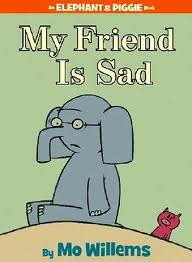
My Friend Is Sad (Mo Willems)

Elephant and Piggie is a book series by Mo Willems. It has a fantastic comic book style, and features two friends: an elephant, Gerald, and a pig, Piggie.

Issues of friendship are addressed: My Friend Is Sad, Should I Share My Ice Cream? Can I Play Too? I Will Surprise My Friend! And my favourite, We Are In A Book!

My Friend Is Sad begins with Gerald, the ellie, who has a very sad face.

Piggie tries all sorts of things to cheer him up: dressing up as a cowboy, a clown and a robot. But Gerald remains sad

Eventually we discover that Gerald is sad because Piggie isn’t there, and because he can’t share the cool cowboy, clown and robot with Piggie – whom he is unable to recognise beyond the disguise. Happily, it all works out in the end, with a clever twist (that I subsequently spotted in all of the Elephant and Piggie books).

Mo Willems’s books are not only gorgeous to look at and easy to read, with very clean, well-designed pages and simple text – they’re also widely recognised: Two books in the series have been listed on Time magazine's ‘Top 10 Children's Books of the Year’: Today I Will Fly in 2007 and Elephants Cannot Dance! in 2009.

In terms of target reader, I’d say parents could read these books to toddlers from age 1, but – as the pages are paper rather than board – solo reading would probably be best from ages 2 to 4. And the range of books would be good to keep, to come back to in primary school, when it comes to navigating friendships and conflicts.

(This review will soon appear on the JoziKids blog.)

17 June 2012

Bear Takes a Trip (Stella Blackstone & Debbie Harter)


[This post originally appeared on the JoziKids blog.]

‘Bear has a very long journey to make. There are lots of things for him to take.’

So he wakes up early, at 7.00am. By 8.30am he’s made his bed, washed his face, eaten his breakfast and packed his case. 

Filled with vibrant illustrations – some of the prettiest and most colourful I’ve seen in a children’s book – this wonderful story introduces little readers to telling the time, but it also has supplementary messages about making preparations, about taking trips and about spending time with friends.

(In terms of age range, I’d say older toddlers – aged 2 to 5 – who are still being read to, and 6- and 7-year olds who are just starting to read for themselves.)

If you’re a family that travels regularly, or that is planning a trip, this is a great way to introduce your kids to getting ready, getting going, being patient and enjoying their surroundings. But beyond that, the story’s core focus is time-telling.

We have a seven-year-old littlie living with us, and she’s starting Clocks at school, so I’m planning on testing this book out with her to see how she likes it…

There are clocks and watches on every page, explanations of ‘noon’, ‘midnight’, ‘quarter to’ and so on, and pictures of different clock faces, with the big and little hands in different positions. I love it. It’s a nice buy, too, for a long car journey.

We All Went on Safari (Laurie Krebs & Julia Cairns)


[This post originally appeared on the JoziKids blog.]

Subtitled ‘A Counting Journey through Tanzania’, this lovely book introduces little readers (I’d say older toddlers – aged 2 to 5 – who are still being read to, and 6- and 7-year olds who are just starting to read for themselves) to three things:

1.     Tanzania
2.     Safaris
3.     Counting

The story starts with a large extended family going on ‘safari’ at the start of a sunny day and spying a lonely leopard. They count ‘one’ (in Swahili, ‘moja’). Then, two (‘mbili’) ostriches running. Then, three (‘tatu’) giraffes grazing. And so on, through beautifully illustrated and laid out pages, to ten (‘kumi’) enormous elephants.

The use of descriptive verbs (‘Up bobbed some hefty hippos’), colourful adjectives (‘Grasslands damp with dew’, ‘Zigzag zebras’) and tidy rhyme is careful and clever. And right at the end, as an extra, are pages on the animals of Tanzania, the Maasai people, Swahili names and their meanings, facts about Tanzania, a map and the full list of numbers, one to ten – all with stunning illustrations and useful pronunciation.

I can’t wait for my littlie to be just old enough to graduate from board books and have this read to her. In the interim, you should buy it. It’s something really different. 

African Animals ABC (Philippa-Alys Browne)


[This post originally appeared on the JoziKids blog.]

I’m not fussy when it comes to choosing books for my one-year-old. But I am discerning. (Which, my husband says, is a euphemism for fussy.)

You see, so many of the kiddie books we’re given have pretty pictures, but rhymes that don’t quite scan. Or missing apostrophes (Its fun at the sea-side.) Or a warped sense of gender roles (He likes to work. She likes to cook.)

And this is why I’m extremely careful when buying books for our daughter. I check them for spelling, grammar, rhymes that flow properly and messages that – while they needn’t be hugely meaningful – aren’t socially worrisome.

Philippa-Alys Browne’s AFRICAN ANIMALS ABC is a magnificent book, and one I can’t wait to read to my daughter. Or, if we’re being accurate, have her ‘read’ to me.

Its pictures are authentic and beautiful African-style illustrations (or perhaps lino-cuts) of African animals – some common, some less so – with an appropriate verb:

Bushbaby blinks
Dassie drinks
Impala grazes
Quail scuttles
Yellow-billed kite soars in the sky

The words chosen are lovely – some are easy, like ‘Crocodile snaps’; others are a bit more challenging, like ‘Porcupine quivers’. And, at the back, there’s a useful blurb on each of the pictured animals for when she’s a bit older or starts asking questions:

The umhutu or mosquito is an insect. The common household mosquito can be found throughout Africa.

Nyala are antelopes that can be found in Southern African. They live and graze in forests and when they are scared, they make a barking sound.

Also, it’s a sturdy board book, which means my little monster can’t rip it to pieces.

In the 13 months of her life, our daughter has been to the bush twice, with a third trip coming up in a few months. So, to have a book with which she can grow accustomed to some of the interesting animals (her word: ‘amals’) we see there, is a great gift.

AFRICAN ANIMALS ABC is also a wonderful gift for foreigners with small children.