And... it's live. Have a look at the Women24 Books page for my review of one of my top 2012 reads: Carol Rivka Brunt's Tell the Wolves I'm Home.
I loved this novel, which tells the story of 14-year-old June and her beloved gay (yes, this really is central to the story) Uncle Finn.
If you appreciate beautiful writing, realistic characters and profound messages, add it to your pile. (Also available on Kindle and from kalahari.net)
www.tiffanymarkman.co.za
A collection of regular-ish book reviews and blog posts by copywriter and editor Tiffany Markman, who reviews for Penguin Books, Pan Macmillan, Women24 and JoziKids - and lives, works, writes and reads in Joburg, South Africa.
28 September 2012
27 September 2012
Upcoming reviews: September
![]() |
| Just because I'm a nerd doesn't mean I can't be a kugel. |
Penguin Books has just delivered JK Rowling's latest adult novel, The Casual Vacancy. I can't wait to get stuck in.
On top of that, I'm also about to start reading:
- Funky Business - The Secrets of an Accidental Entrepreneur (Ronnie Apteker, Gus Silber)
- Sweet Tooth (Ian McEwan)
- Spark Your Dream (Candelaria & Herman Zapp)
- Tommy Toad (Joy Sachs)
Chat soon.
Tiffany
www.tiffanymarkman.co.za
04 September 2012
The Top Prisoner of C-Max (Wessel Ebersohn)
I’ve said before that I’m not a wild fan of local crime
fiction. But Wessel Ebersohn was the writer who converted me, so it’s highly
appropriate that I’m reviewing his latest offering. (And, although The Top Prisoner of C-Max is the sequel
to Ebersohn’s The October Killings,
I’ve not read the latter and I still enjoyed this book thoroughly.)
To begin with, The
Top Prisoner of C-Max brings back oddball Jewish psychologist, Yudel Gordon
– who fascinated me in Those Who Love
Night – and pairs him with talented lawyer Abigail Bukula. There’s also the
improbably named Beloved Childe, an American prisons prodigy, and a cast of highly
charged, overly politicised, brightly colourful and deeply scary characters in
the post-1994 Dept of Correctional Services.
At Pretoria’s high-security prison, C-Max, convicts are
now called ‘inmates’ and warders ‘members’, and Yudel is trying to find his
professional feet in ‘the new country’. Enslin Kruger, a brutal criminal, is on
his last legs and wants to exact revenge on Yudel before he dies, by
establishing a prison contest to choose his successor: The first of two men to murder
the beautiful Beloved takes the throne.
Twenty-five years before our story begins:
“Yudel did not see the man with the shovel move. He also did not
see Masuku fall, but now he was down on his hands and knees. Exactly what had
happened, how he had lost his balance, whether or not he had had been pushed or
even where the man with the shovel had been standing, had not been clear to
Yudel afterwards. All that he remembered with any sort of clarity was that
within a moment of Masuku landing on his hands and knees, three picks had been
driven into his skull, and power among the prisoners had passed into the hands
of Enslin Kruger.”
Despite a contained start within the prison itself, the
story is packed with chases, subtle in its violence and authentic in its
dialogue. What’s also interesting is that this is the latest of six thrillers featuring Yudel Gordon, the
first of which was penned in the 1980s. My, my – how times have changed for the
character and his allies.
29 July 2012
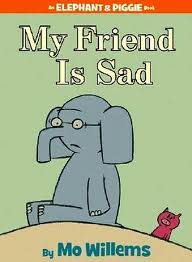
My Friend Is Sad (Mo Willems)
Elephant
and Piggie is a book series by Mo Willems. It has a
fantastic comic book
style, and features two friends: an elephant, Gerald, and a pig, Piggie.
Issues of friendship are addressed: My Friend Is Sad, Should I Share My Ice Cream? Can I Play Too? I Will Surprise My Friend! And my favourite, We Are In A Book!
My Friend Is Sad begins with Gerald, the ellie, who has a very sad face.
Piggie tries all sorts of things to cheer him up: dressing up as a cowboy, a clown and a robot. But Gerald remains sad
Eventually we discover that Gerald is sad because Piggie isn’t there, and because he can’t share the cool cowboy, clown and robot with Piggie – whom he is unable to recognise beyond the disguise. Happily, it all works out in the end, with a clever twist (that I subsequently spotted in all of the Elephant and Piggie books).
Piggie tries all sorts of things to cheer him up: dressing up as a cowboy, a clown and a robot. But Gerald remains sad
Eventually we discover that Gerald is sad because Piggie isn’t there, and because he can’t share the cool cowboy, clown and robot with Piggie – whom he is unable to recognise beyond the disguise. Happily, it all works out in the end, with a clever twist (that I subsequently spotted in all of the Elephant and Piggie books).
Mo Willems’s books are not only gorgeous to look at and easy to read,
with very clean, well-designed pages and simple text – they’re also widely
recognised: Two books in the series have been listed on Time
magazine's ‘Top 10 Children's Books of the Year’: Today I Will Fly in 2007 and
Elephants Cannot Dance! in 2009.
In terms of target reader, I’d say parents could read these books to
toddlers from age 1, but – as the pages are paper rather than board – solo
reading would probably be best from ages 2 to 4. And the range of books would
be good to keep, to come back to in primary school, when it comes to navigating
friendships and conflicts.
(This review will soon appear on the JoziKids blog.)
Recognising Postnatal Depression (Aarons, Levin & Taub-Da Costa)
Subtitled 'A Handbook for Mothers', Recognising Postnatal Depression is available from all leading bookstores, thanks to Penguin Books South Africa.
As I began to page through this book, just the first few chapters, I kept having to stop and verbalise out loud how much I wish we’d had a copy when I started to experience symptoms of PND.
But, even in the early days, I was too far gone to read it
myself. That’s why I think this book should be required reading for any husband
who suspects that his wife isn’t 100%. Or any granny, friend, sister…
As the authors say, upfront:
"This book may not be for you but you may want to read it anyway since we can guarantee that many of the mothers you care deeply about are somewhere inside that rainbow [of reactions to having a baby: antenatal depression, postnatal euphoria, baby blues, postnatal stress, postnatal depression, bipolar mood disorders and postnatal psychosis]."
It’s written by three women: Andy Taub-Da Costa, Paula Levin
and Zahava Aarons – two of whom have had PND and two of whom are mental health
specialists.
However, despite the authentic medical and psychological
info in the book, its style and tone remain refreshingly ‘real’: They use ‘yummy mummies’, ‘I’ and ‘we’,
‘throwing in the towel’, etc. Un-scary language.
The book defines PND, with ways to tell if you have it and
what to do if that’s the case. There are true stories from women who’ve beaten
it, including Sam Cowen and Deborah Patta.
There’s also a big chapter on psychotherapy (which, together
with a brilliant psychiatrist and the right medication, was what ultimately
saved me). And the book concludes with a chapter on treating PND ‘spiritually’.
For me, the strongest element of this book is the way it
combines real medical thinking – Wolf, Winnicott, local psychiatrist Dr Rykie
Liebenberg and others – with real human experience, in real human language.
The only other book on PND I’ve read is Brooke Shields’ Down Came the Rain, which I hated. (One
of the authors applauds it, so that’s something, but I read it in the midst of
my own depression and it helped me not at all.)
Unlike some of the mommies referred to in the Introduction,
I’m not a propagandist of ‘blissful motherhood’, because I do honestly, unapologetically and (lord help me) publicly admit the
hell I went through. But I do this because, when I was lost in the dark, I
thought I was the only one. So, in a sentence, thank G-d for this book.
Subscribe to:
Posts (Atom)